Enter a disclosed RTP to calculate the matching house edge. Optional stake and round fields illustrate a theoretical long-run average only. The result is not a prediction, does not account for volatility and cannot describe what will happen in one session.
Information reviewed 2026-08-09 · Adults 18+
LOTWINKNOW BEFORE YOU PLAY
Local browser calculation
Convert RTP to house edge
Required: RTP. Optional: add both stake per round and number of rounds for a theoretical long-run illustration.
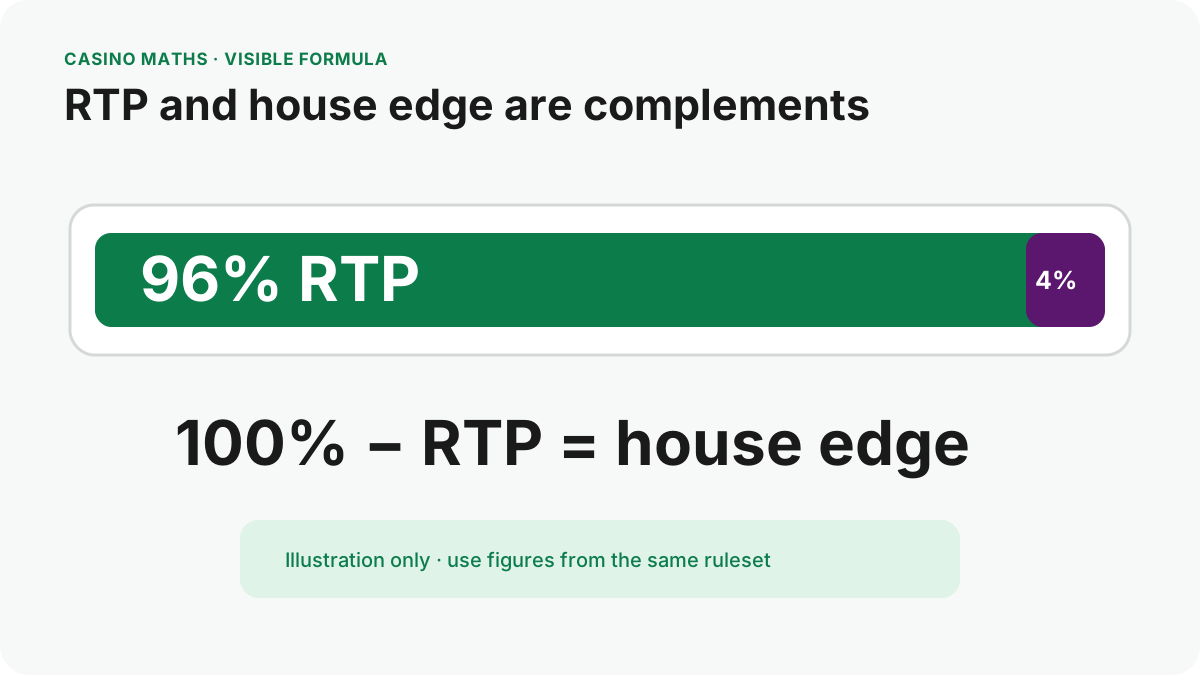
House edge = 100% − RTP
Worked example: 96% RTP means a 4% house edge. Across 2,000 consistent stake units, the theoretical long-run return is 1,920 units and the theoretical cost is 80 units.
Enter an RTP to see the mathematical relationship.
01
Formula and assumptions
House edge = 100% − RTP. If optional fields are used, total staked equals stake per round multiplied by rounds, and theoretical return equals total staked multiplied by RTP. Treat every optional amount as the same consistently chosen stake unit.
02
Why an individual result will differ
RTP is designed as a long-run theoretical measure over many plays under stated rules. Random variation, game volatility, feature structure and the size of the sample can produce results far above or below the illustration.
The formula behind the calculatorHouse edge equals 100% minus RTP when both figures use the same basis. The output remains a theoretical long-run relationship. On a small screen, swipe the diagram horizontally to inspect its labels.
Selected reading
Go deeper with sourced guides
These existing articles provide the detail, sources and publication context behind this overview.
Understand RTP as a theoretical long-run percentage, learn when 100% minus RTP equals house edge, and use a transparent calculator without predicting a session.
What is variance, and why does it matter for Nigerian casino players? Learn how short-term luck differs from long-term expectation, and how to handle the swings.