
What is basic blackjack strategy?
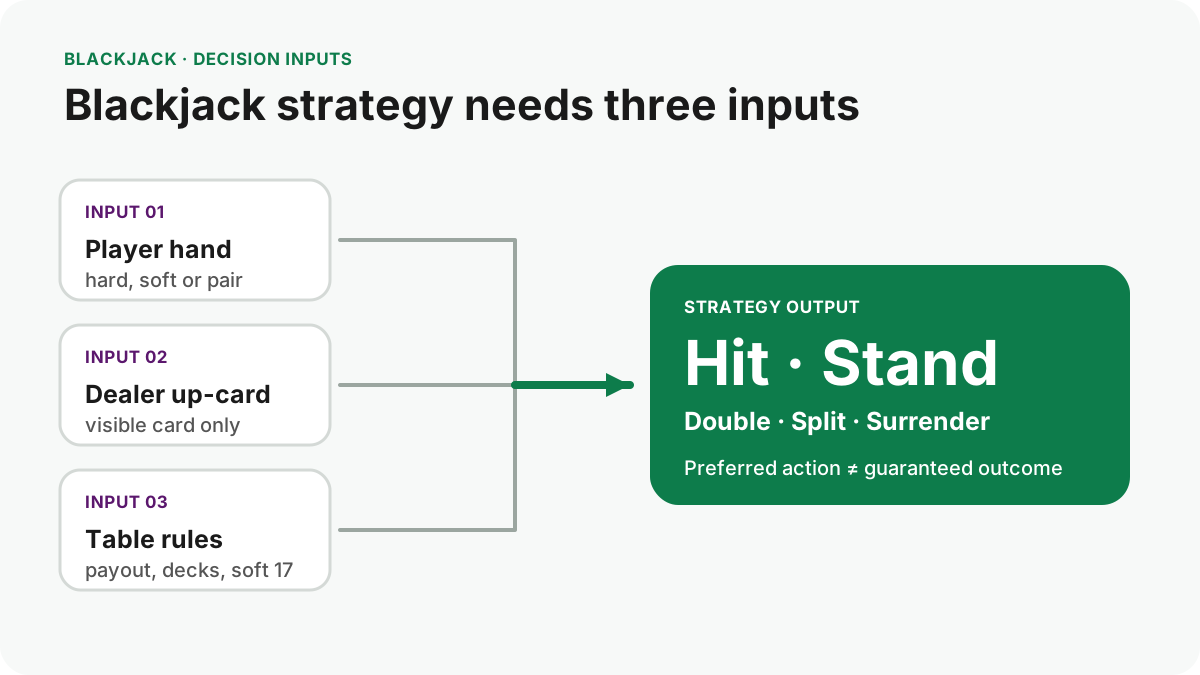
Basic blackjack strategy is a decision guide for choosing hit, stand, double, split or surrender from three inputs: the player's hand, the dealer's up-card and the exact table rules. It aims to reduce avoidable decision errors over many hands. It does not predict the next card, guarantee a win or remove the house edge.
A chart is only valid for the rules it was calculated for. Before using one, check the table's deck count, blackjack payout, dealer action on soft 17, doubling restrictions, surrender option and rules after splitting.
How a blackjack round works
The player tries to finish with a hand closer to 21 than the dealer without going over 21. Number cards use their face value, picture cards count as 10 and an Ace can count as 1 or 11. A natural blackjack normally means an Ace with a ten-value card in the first two cards, but its payout and the dealer's checking procedure depend on the displayed rules.
The main decisions are:
- Hit: take another card;
- Stand: end the player's draw;
- Double: increase the initial stake under the table rules and receive one final card;
- Split: turn an eligible pair into separate hands under the table rules;
- Surrender: give up part of the stake where that option is offered.
Use the Blackjack learning hub for the round sequence and the rule details to record before comparing charts.
Why the table rules come first
Small rule changes can change the mathematically preferred action and the long-run house edge. Check:
- single-deck or multi-deck play;
- whether the dealer stands or hits on soft 17;
- the displayed payout for a natural blackjack;
- when doubling is allowed;
- whether doubling after a split is allowed;
- whether surrender is available;
- how split Aces and re-splitting are handled.
Do not copy one chart into a different ruleset. If the chart does not identify its assumptions, it is not precise enough for a rule-dependent decision.
Hard, soft and pair hands
A hard hand either has no Ace or counts every Ace as 1. A soft hand includes an Ace currently counted as 11 without busting. A pair hand may be eligible for splitting. Strategy charts separate these groups because the available safe draws and alternative actions differ.
The dealer's visible card is the other major input. A chart compares the player's current hand with that up-card under a fixed ruleset. It does not assume that a past run changes the next draw.
How to use a strategy chart correctly
- Confirm that the chart matches the table rules.
- Identify whether the hand is hard, soft or a pair.
- Find the dealer's up-card.
- Read the chart action and any fallback if double, split or surrender is unavailable.
- Keep bankroll and time limits separate from the chart; a mathematically preferred action can still lose.
The casino maths hub explains house edge and variance. Those long-run concepts describe repeated play, not the result of a particular hand or session.
Common misunderstandings
- “Basic strategy guarantees profit.” It does not. It reduces decision errors within the selected ruleset.
- “The cards are due after a losing run.” Past outcomes do not create a promise about the next hand.
- “Every blackjack game uses the same chart.” Deck count, payouts and dealer rules can require different actions.
- “A side bet is part of basic strategy.” Side bets have their own rules and probabilities.
- “A general guide proves product availability.” It does not confirm that a blackjack table, demo mode or particular rule set is currently available through Lotwin.
Safer use of strategy information
Treat a chart as educational decision support, not as a reason to raise stakes or chase losses. Decide a spending and time limit before play, stop when the limit is reached and never rely on gambling to solve a financial problem. See Responsible Play for independent support and safer-play guidance.